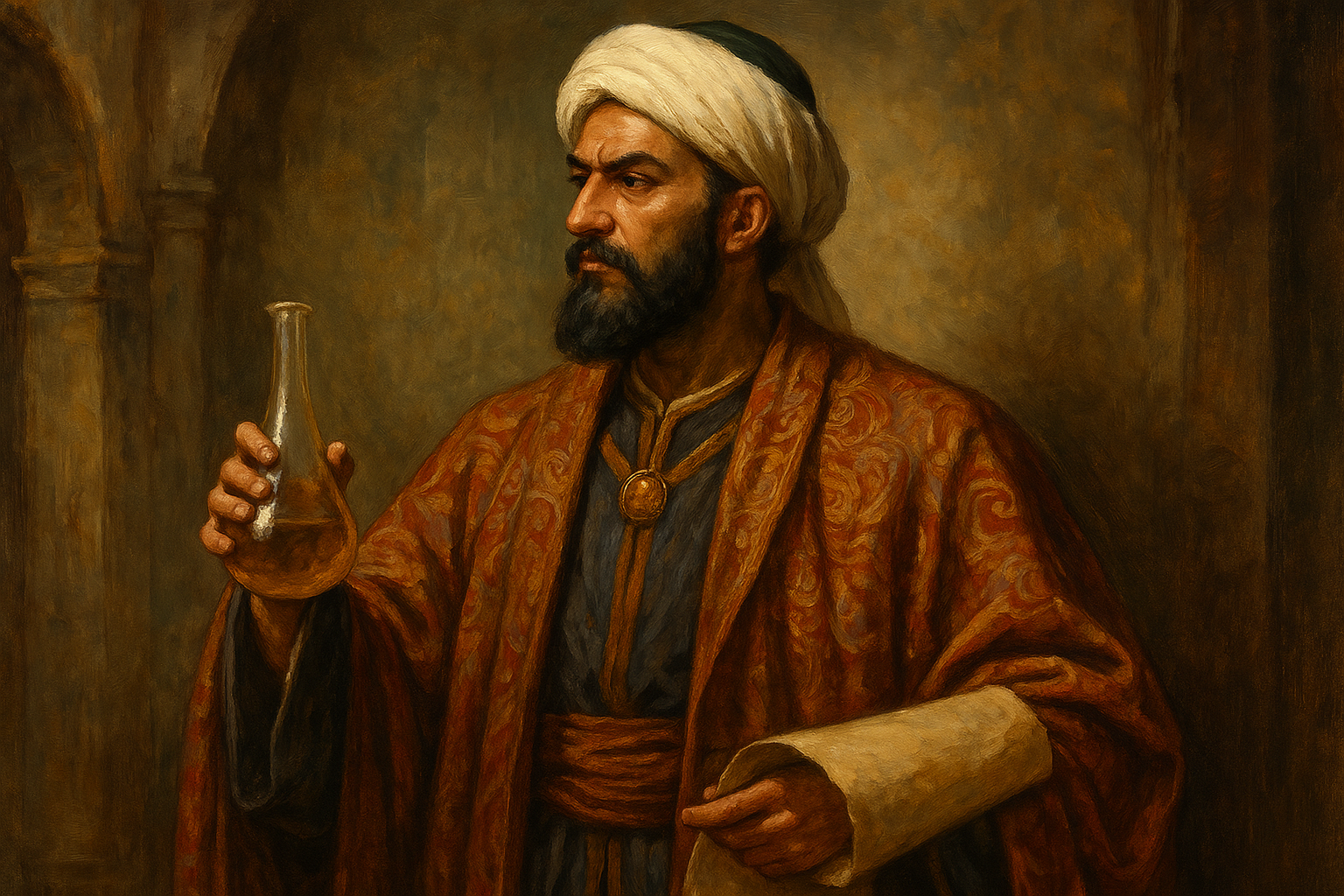
Khālid ibn Yazīd
We will explore how this young Umayyad heir, once poised to rule an empire, instead became famous for mysticism, alchemy, and esoteric knowledge. From his upbringing amid the splendor and strife of a rising Islamic empire, to the tales of secret teachings under a Christian hermit, Khālid’s story is rich with human drama and supernatural appeal.
“I only pursue this art so that I may enrich my companions and brothers… I once craved the caliphate and it was denied me, so I found solace only in attaining the ultimate knowledge of this craft – such that no one who has known me will ever need to stand at a ruler’s door out of want or fear.”
The journey of Khālid ibn Yazīd is not just a historical chronicle but a window into the occult heritage of early Islam. Why does he deserve a feature on The Occult Rejects? Because his life embodies the very crossroads of power and arcane knowledge – a royal alchemist who “pursued that which is impossible” in the eyes of contemporaries, yet inspired generations of later scientists, mystics, and artists. Today we will walk through Khālid’s life: his princely youth during the Second Islamic Civil War, the heartbreak of losing a throne, his retreat into scholarly solitude, and the legacy of texts and legends that sprouted around his name. By the end, you’ll understand how Khālid ibn Yazīd’s quest for wisdom left an imprint on occult lore, religious thought, and the scientific imagination, making his tale a perfect fit for an exploration of the rejected and the arcane.
“Redeamus nunc ad expositionem Trium Verborum, in quibus tota ars consistit.”
“Let us return to the exposition of the Three Words, in which the whole art consists.”
Early Life in a Growing Empire
Khālid was born around 668 CE (48 AH) into the ruling family of the Umayyad Caliphate, a dynasty then consolidating its grip over the recently expanded Islamic world. His father was Caliph Yazīd I, and his grandfather was Mu‘āwiya I, founder of the Umayyad state. Thus, Khālid grew up in the elite circle of Damascus, the Umayyad capital, enjoying the privileges of a princely upbringing. We can imagine him as a child in the lavish courts of Syria – educated by tutors in Qur’anic studies, Arabic poetry, and perhaps even exposed to Greek or Syriac learning through local Christian scholars. His mother, Fakhita, was herself from a prominent clan. This noble heritage imbued Khālid with a sense of destiny from an early age.
The world Khālid was born into was one of dynamic change and cultural fusion. The Muslim empire had exploded out of Arabia in the mid-7th century, conquering lands from Persia to Egypt. By Khālid’s youth, the Umayyad Caliphate stretched across the Middle East and North Africa, ruling over diverse peoples (Greeks, Persians, Copts, etc.) and inheriting centers of ancient knowledge like Alexandria. The atmosphere in Syria was cultured – Arabic was the new official tongue, but Greek and Aramaic intellectual traditions still lingered in schools and monasteries.
This environment likely influenced Khālid’s later intellectual curiosity. Indeed, the conquest of Alexandria in 642 had put Muslims in contact with “the bulk of Greek philosophy and science, including alchemy”, planting seeds of scientific interest that Khālid would later nurture. One medieval Arab writer, al-Jāḥiẓ, gives us a fascinating glimpse of Khālid’s character as a young man:
“Khalid ibn Yazid was an orator, a poet, and was eloquent, comprehensive, of sound judgment and extremely well-mannered”
Such praise suggests he was not only of noble blood but also carefully educated in rhetoric and literature, standing out among his peers for his intellect.
Life in the Umayyad court also meant exposure to politics and warfare early on. Khālid spent his childhood and teens amid the turmoil of the Second Fitna (Islamic civil war). When he was about 15, his father Yazīd I died (683 CE) and power passed briefly to Khālid’s elder half-brother Mu‘āwiya II. But within months Mu‘āwiya II also perished, plunging the caliphate into a succession crisis. Though very young (perhaps 16), Khālid suddenly found himself a potential candidate for the throne of an empire.
Map of the Islamic Caliphate’s expansion by 750 CE. Khālid’s lifetime (668–704) fell during the Umayyad period (light green), when the empire was based in Syria and rapidly enlarging. Growing up in this era, Khālid witnessed a world of conquest, multicultural exchange, and the consolidation of Islamic rule across three continents.
Education and Influences: Tutors, Traditions, and the Monk Morienus
Khālid’s education unfolded inside a Umayyad court that drew on Arab adab, Qur’anic study, and the Syriac-Greek learning of greater Syria. Later Arabic reportages (9th–10th c.) remember him not merely as a prince but as a seeker who turned from politics toward “the Divine Art.” Those same sources pair him with a Byzantine (often styled “Greek”) monk named Maryānus/Morienus, a reclusive sage of Palestine or Syria. In the classic Arabic dossier—later translated into Latin as the Liber de compositione alchemiae—Morienus teaches Khālid in a sustained dialogue, framing the Art as both a science of substances and a path of purification. Medieval writers even make Morienus a pupil of Stephanos (Stephanus) of Alexandria, visually stitching Khālid into a late-antique chain of transmission.
It is through this very legend that Khālid’s influences come into focus: Alexandrian Hermetism and Neoplatonism; Syriac monastic craft lore; astrological cosmology; and the practical metallurgies of the eastern Mediterranean. In short, whatever the historical literalness of Morienus, the dossier accurately maps the currents of knowledge that fed Arabic alchemy and that medieval readers believed Khālid embodied.
The Morienus dialogue—Latin Liber de compositione alchemiae (Robert of Chester, 1144)—is the earliest well-documented Arabic → Latin alchemy translation and the chief literary source for the “Khālid’s teacher” storyline. It is precisely this text that made Khalid & Morienus household names among medieval and Renaissance alchemists.
“Nam et alia natura est in muliere praegnante, et alia in Mercurio.”
“For the nature in a pregnant woman is one thing, and in Mercury another.”
Struggle for the Caliphate and Political Eclipse
In 684 CE, the Umayyad elite gathered to resolve the leadership crisis. Khālid, though of the ruling house, was still a teenager – “much younger” than other contenders. The Syrian nobles opted to bypass him in favor of an older statesman, Marwān ibn al-Ḥakam, who hailed from a different branch of the Umayyad clan. Marwān was chosen as caliph on the condition that Khālid would be named heir after him. To seal this pact, Marwān married Khālid’s mother (the young widow Fakhita), strengthening the familial bond. For a moment, it seemed Khālid’s royal ambitions were merely deferred – he might ascend the throne after Marwān’s reign.
However, power struggles intervened. Once firmly in power, Marwān reneged on the deal: he removed Khālid from succession and designated his own sons as heirs instead. When Khālid reminded Marwān of his promise, the caliph reportedly “publicly insulted [Khalid’s] mother Fakhita.” Enraged and dishonored, Fakhita is said (in later legend) to have murdered Marwān in revenge by suffocating him with a pillow.
While historians doubt this dramatic tale, it captures the intensity of betrayal Khālid experienced. In the span of a year, he went from rightful heir of Mu‘āwiya’s lineage to a sidelined prince who had lost both his father and his promised throne. The Arabic chronicler al-Mada’ini summed up Khālid’s plight with the remark – that he was “pursuing that which is impossible, that is, alchemy”. Many interpret this as a metaphor: Khālid’s political ambitions (like the alchemist’s dream of turning lead to gold) had proved futile. This quote, possibly misread by later writers, would ironically spark the legend of Khālid the alchemist (more on that soon).
Despite the setback, Khālid adapted fast. He forged a close friendship with Marwān’s son, the new Caliph ʿAbd al-Malik (r. 685–705). Rather than rebelling, Khālid served ʿAbd al-Malik loyally and was rewarded with influential roles. In 691, during a decisive campaign to reunify the fractured Caliphate, ʿAbd al-Malik appointed Khālid as a commander in the siege of al-Qarqīsiyā (Circesium) against a rebel faction.
He then led the left wing of the Umayyad army at the Battle of Maskīn (691), which crushed the rival caliphate of Ibn al-Zubayr in Iraq. These victories restored Umayyad control over the eastern provinces. Khālid, still only in his early twenties, had proven his mettle on the battlefield and earned the trust of the caliph. As further affirmation, ʿAbd al-Malik married his own daughter ʿĀ’isha to Khālid, making Khalid his son-in-law. By blood and loyalty, Khālid was now firmly integrated into the ruling family (even if he would never wear the caliphal crown himself).
After these eventful years, Khālid ibn Yazīd made a crucial choice: he withdrew from public life. Around 692 or shortly thereafter, Khālid left the political and military arena and settled in Homs (Emesa) in central Syria. ʿAbd al-Malik granted him the governorship of Homs as a kind of estate, and there Khālid “lived out the rest of his life” in relative seclusion. One might speculate on his motives – perhaps the cutthroat nature of court politics and the trauma of his earlier disappointment left him disillusioned with power. By retiring to Homs, Khālid gained something he may have longed for: peace and time for intellectual pursuits. Later sources hint that in Homs he engaged in scholarly and artistic activities, such as writing poetry and studying hadith (Prophetic traditions). We can picture him as a regional prince-patron, holding learned discussions in his villa, far from the intrigues of Damascus.
This period of quiet retirement set the stage for Khālid’s transformation into a legendary wise man. Freed from worldly ambition, he now turned his formidable mind toward the “wisdom of the stars and the secrets of substances”. The relative obscurity of his final decade allowed legends to grow. There is scant contemporary record of Khālid’s specific activities in Homs, but within a century or two, stories began to circulate that this princely dropout had immersed himself in alchemy and occult sciences. As we shall see, what Khālid actually did in Homs is less documented than what later generations imagined he did – and those imaginations ran wild, casting Khālid as the seminal “Philosopher Prince” of the Islamic world.
The Legend of the Alchemist Prince
By the 9th century, Khālid ibn Yazīd’s name had become enshrined in Arabic lore as a master of alchemy and the occult. This is an interesting evolution: in his own time Khālid was known as a poet, patron, and ex-prince, not necessarily an alchemist. So how did this legend take shape? A combination of later historical writing, pseudonymous texts, and oral tradition built the image of Khālid as “the first Muslim alchemist”.
One early thread came from the historian al-Balādhurī (d. 892), who, as noted, quoted his teacher al-Mada’ini’s witty description that Khālid busied himself with “alchemy” in the figurative sense. It appears that al-Balādhurī took it literally – or at least helped spread the anecdote that Khālid “was pursuing that which is impossible, i.e., alchemy.” Later writers seized on this as evidence that Khālid dabbled in the Art. Soon, other prominent scholars repeated the association. The great adīb al-Jāḥiẓ (776–868) praised Khālid’s learning and explicitly wrote that “He was the first (in Islam) who ordered the translation of works on astronomy, medicine and alchemy.” This claim, though historically dubious , was hugely influential. It portrayed Khālid as a pioneer of science, a royal patron who kick-started the translation of Greek knowledge into Arabic. In the popular imagination, Khālid became “the Arab Hermes” – a conduit of ancient wisdom into the new Muslim empire.
Another key figure, the bibliographer Ibn al-Nadīm (10th century), firmly cemented Khālid’s alchemical reputation. In his famous catalogue Al-Fihrist, Ibn al-Nadīm wrote: “the first Muslim alchemist was Khālid ibn Yazīd, who is said to have studied alchemy under the Christian Maryānus (Morienus) of Alexandria.” This succinct statement packs in the core of the legend: Khālid as disciple of a mysterious Christian sage, learning the secrets of al-kīmiyā’. We’ll examine that story momentarily. Ibn al-Nadīm also listed several alchemical books attributed to Khālid (we will detail those in the next section), indicating that by 987 CE, a substantial corpus bore Khālid’s name.
Why Khālid specifically? Scholars have theorized on the legend’s origins. One view (Manfred Ullmann’s) is that a simple misunderstanding gave birth to it: al-Mada’ini’s quip about Khālid “pursuing the impossible” was glossed by al-Balādhurī as literal alchemy, thereby accidentally inaugurating the myth. Another view (Pierre Lory’s) suggests the texts attributed to Khālid were actually composed in humbler circles (perhaps by early occultists who lacked noble patronage) and then ascribed to a prince to grant them prestige.
By attaching their work to the famous Umayyad royal, these 8th–9th century alchemists gave their writings an aura of antiquity and authority. In any case, from the 800s onward, Arabic writings frequently mention Khālid as an alchemist. Authors like al-Jāḥiẓ, al-Ṭabarī, and Abu’l-Faraj al-Iṣfahānī all name-dropped him as a pioneer in the occult arts. The legend had eclipsed reality.
At the heart of Khālid’s alchemical lore is the captivating tale of his mentorship under Morienus, often called Maryānus in Arabic. This story is the closest thing we have to a “personal anecdote” about Khālid’s mystical wanderings and it reads almost like spiritual adventure literature. According to later accounts (preserved in a Latin work we’ll soon discuss), Khālid in his quest for the secrets of creation learned of a Greek monk and hermit named Maryānus (Morienus) who dwelt in Palestine or Syria. Maryānus was said to be a reclusive sage, “an ancient adept and hermit of Jerusalem”, rumored to possess the Philosopher’s Stone and able to “produce gold each year” from base metals. Intrigued, Prince Khālid dispatched messengers and personally sought out this wise hermit. Eventually he found Morienus living ascetically in the wilderness near Jerusalem. In a dramatic meeting, Khālid invited the elderly monk to his court. Morienus, clad in a coarse hair-shirt and exuding an aura of wisdom, agreed to share his knowledge. It’s said that Khālid visited Morienus daily, sitting at the feet of the hermit to discuss philosophy, history, and the hidden arts. Over time, Morienus initiated Khālid into the deepest secrets of alchemy – the knowledge of transmuting metals and achieving inner purification. This master-disciple relationship echoes the archetypal transfer of Hermetic wisdom from the fading Byzantine world to the nascent Arabic world.
One Arabic source even provides a chain of transmission: Jabir ibn Ḥayyān (the 8th-century “father of Islamic alchemy”) mentions that he studied alchemy under a monk who was a pupil of Maryānus, the tutor of Khalid ibn Yazid. In other words, Jabir claims his teacher’s teacher was Khālid’s teacher – forming a neat lineage of occult knowledge from Alexandriato the Umayyad court (via Khālid) and then to the Abbasid era (via Jabir). This lineage may not be historically true, but it was psychologically true for medieval alchemists who craved continuity with antiquity. Through Khālid, they linked themselves to the ancient Hermetic tradition going back to Hermes Trismegistus.
The tale of Khālid and Morienus was immortalized in a book that became extremely influential in both the Islamic and European alchemical corpus: “Kitāb Masāʾil Khālid li-Maryānus”, or “Khalid’s Questions to the Monk Maryanus.” In this dialogue, Khālid poses queries and Morienus reveals the answers, essentially laying out the steps to create the elixir (al-iksīr) or philosopher’s stone. The text was translated into Latin in 1144 by Robert of Chester under the title “Liber de Compositione Alchemiae” – notable for being the first Arabic alchemical work ever rendered into Latin. In the preface, the translator exclaims the novelty of this science to the West: “Since what Alchymia is, and what its composition is, your Latin world does not yet know, I will explain it in the present book”.
The content that follows introduced European readers to the mystical dialogue of Khālid and Morienus, describing alchemical concepts in allegorical language. For example, Morienus tells Khālid that “the thing, O King, is extracted from thee... with thee it is found, by thee it is received”, hinting that the ingredients of the Work come from nature and the self, and that the king himself (Khālid) holds the key within. Such cryptic wisdom would fascinate alchemists for centuries.
So powerful was the legend of Khālid’s tutelage that his and Morienus’s names became revered in medieval alchemy. One historian writes that “The names of Morienus (Maryanus) and Khalid became well known to all alchemists in Europe. Their importance matched that of al-Razi, Ibn Sina and Jabir. In other words, European alchemical texts placed “Calid rex” (King Khālid) alongside luminaries like Rhazes, Avicenna, and Geber. An engraving from the 17th century even depicts Morienus the Greek and King Khālid ibn Yazīd sitting together, symbolizing the handoff of esoteric knowledge (an image often reproduced in alchemy compendiums of that era).
With the legend firmly established, Khālid ibn Yazīd’s historical persona was transformed. To later eyes, he was no longer primarily a failed claimant to the Caliphate or a provincial governor – he was the wise prince who chose wisdom over worldly power. In a sense, Khālid became an occult role model: a man who turned his back on the throne to seek enlightenment in the hidden arts. This dramatic arc, full of mystical allure, ensured that Khālid’s name lived on far longer than many actual caliphs’. Next, we will cover the writings attributed to him – the body of work that cements his status as an author of alchemical doctrine.
“Aqua enim dicitur tribus mensibus foetum in matrice conservare. Aër tribus mensibus fouet. Ignis totidem custodit.”
“Water is said to preserve the fetus in the womb for three months. Air warms it for three months. Fire guards it the same span.”
Alchemical Works Attributed to Khālid
A large number of alchemical treatises, epistles, and poems are credited to Khālid in various manuscripts. Modern scholars generally view these texts as works written by unknown authors between the 8th–10th century, but ascribed to Khālid to lend them authority. Nonetheless, they form a fascinating corpus reflecting early Islamic alchemical thought. Here I will touch on some of his major works:
“Dīwān al-Nujūm wa-Firdaws al-Ḥikma” – “The Registry of the Stars and the Paradise of Wisdom.” is described as a collection of alchemical poems and treatises attributed to Khālid. The title suggests a cosmic or philosophical framing of alchemical knowledge. In essence, it is an anthology of didactic poetry on alchemy, likely interspersed with short prose sections. One Arabic source explicitly calls al-Firdaws “a diwan of poetry in alchemy”, indicating that the work chiefly consists of verse odes expounding chemical lore. These poems probably employ rich symbolism of stars, minerals, and the “wisdom paradise” of alchemy’s secrets. For example, one verse ascribed to Khālid emphasizes keeping alchemical wisdom hidden: “Wa-innī la-ukmī al-nāsa mā ana muḍmir / makhāfata an yathrī bi-dhālika kāshiḥ” – “Truly I conceal from people what I harbor (of knowledge), for fear that a spiteful rival might enrich himself by it.”. This couplet reflects the esoteric ethos of the text: alchemy’s truths are veiled to prevent misuse by the unworthy.
The Diwān is believed to have been compiled at a relatively late date (perhaps 13th–15th century) by later alchemists drawing on earlier materials. It may incorporate poems circulating in alchemical circles and compile them under Khālid’s name to create a prestigious “legacy.” The original language is Arabic, and no medieval Latin version is recorded. While medieval bibliographers like Ḥajjī Khalīfa (Kashf al-Ẓunūn) mention “The Registry of the Stars” among Khālid’s works, there is no evidence Khālid himself wrote this anthology – it is considered legendary attribution. Modern scholars (e.g. M. Ullmann, P. Lory) suggest such attributions aimed to ennoble humble or anonymous alchemical poetry by linking it to a famous Umayyad prince.
“Kitāb Waṣiyyatihi ilā ibnihi fī al-ṣanʿa” – “The Book of his Testament to His Son on the Art.” This work is known as Khālid’s spiritual and practical advice to his son regarding the “Art” of alchemy. It is essentially a testament or lengthy letter in which a father (Khālid) hands down alchemical doctrine to the next generation. This text is not widely published.
Ibn al-Nadīm, in his Fihrist, records having seen “The Book of the Testament to His Son on the Art” among four works of Khālid. This indicates the writings existed by the 10th century. Its original language is Arabic, and it was never translated into Latin, suggesting a primarily Middle Eastern circulation. Scholars unanimously regard the text as a later writer’s creation. It may date from the 9th or 10th century, when the legend of Khālid as an alchemist was flourishing. The didactic “father-to-son” genre was a known literary device often used to convey secret knowledge. Thus, a later alchemist likely adopted Khālid’s persona to lend authority to his own teachings. Manfred Ullmann (1978) and Sébastien Moureau (2021) note that such attributions reflect the image of Khālid as a sage carefully instructing his heir, which aligns with the narrative of him being “noble-minded and deeply enamored of sciences”.
Unlike the more popular Khalid’s Questions to the Monk Maryanos, (see below), the The Book of his Testament to His Son on the Art is less widely attested. It was certainly extant in the medieval period (as the Fihrist attests), but many copies may have been lost. Modern researchers have identified at least one manuscript: a copy of writing was noted by Fuat Sezgin as an item, and a PDF of a manuscript was circulated in a private forum in 2018, implying it survives in a collection. The “The Book of his Testament to His Son on the Art.” has not yet seen a printed edition or translation, remaining accessible only through manuscript studies. Libraries in the Middle East could possibly hold unstudied copies under variant titles (often works of this genre are simply titled “Waṣiyyah fī l-kīmiyāʾ” in catalogs).
“Masā’il Khālid li-Maryānus al-Rāhib” – “Khalid’s Questions to the Monk Maryanos,” also known as “Risālat Maryānus al-ḥakīm li-l-amīr Khālid” – “The Epistle of the Wise Monk Maryanos to Prince Khalid.” This is perhaps the most famous work attributed to Khālid. This is a dialogue between Prince Khālid and a Byzantine monk, Maryānus (Morienus), who instructs him in alchemy. In the Arabic, it is framed as an epistolary discourse – often titled Risālat Maryānus al-ḥakīm ilā Khālid (Epistle of the Wise Monk Maryanus to Khālid) – consisting of questions by Khālid and answers by Maryānus. The text opens with a narrative prologue: Khālid, eager to learn alchemy, hears of a Christian hermit in Jerusalem (Morienus) famed for his mastery of the Art. Khālid sends for him, and Morienus comes to Damascus to become his teacher. This dramatic encounter is vividly described – “I dwell in Jerusalem,” the man tells Khālid, “and I know of a hermit called Maryanus the monk who has achieved the Art. He comes each year to Jerusalem, giving great sums to the poor…”. Khālid entreats Morienus for knowledge, and the core of the text ensues: Maryānus reveals the secrets of the “Great Work” (al-ʿAmal al-Aʿẓam) in a series of didactic exchanges.
“O Morienus, know that I have long sought the Superior [Great] Work, but found none to counsel me in this matter. Therefore I earnestly request that you prepare for me some portion of your magistery. You shall have from me then whatever you may ask, and I will see to it that you return to your own land, God willing….”
The dialogue covers classical alchemical doctrine: the nature of the Philosopher’s Stone (al-iksīr), the unity of metals, the stages of transmutation, and allegorical descriptions of chemical operations. Maryānus uses cryptic imagery – describing the “One Thing” that conquers all, the marriage of Sun and Moon (gold and silver), and the generation of the Elixir. For example, he explains that the Stone is composed of a spirit and a body united, which must be repeatedly dissolved and coagulated. The Latin translation famously includes the line “Arabice appellatur elixir” (in Arabic it is called al-iksīr) when introducing the Philosopher’s Stone.
The Masāʾil is structured as questions by Khālid (“What is the essence of the Stone? How do we prepare it?”) and answers by the monk, often in elaborate metaphor.
At one point, Morienus declares: “Take one part of the Sun and one of the Moon...” indicating gold and silver as ingredients, couched in Hermetic symbolism. The dialogue emphasizes divine inspiration: Morienus attributes the power of transformation to God’s will, aligning the mystical aspect of alchemy with its practical instructions. By the end, Khālid is said to have grasped the “Divine Secrets of the Magisterium”, having received Morienus’s testament of wisdom.
Though set in the late 7th century, the text itself was written much later. Scholarly consensus places it in the early-to-mid 10th century CE. Pierre Lory (1989) even proposed an 8th-century origin for some parts, but more recent analysis by Marion Dapsens suggests a 10th-century compilation. The author is unknown – possibly an Arabic-speaking Christian or Sabian alchemist familiar with Hermetic dialogues. The work shows syncretism of Greek, Alexandrian, and early Islamic alchemical ideas, consistent with the atmosphere of Baghdad or Syria in the 9th–10th centuries.
It purports to preserve a legendary moment: the transmission of Byzantine alchemy to the Arab world. In reality, this legend likely evolved over time. By the 9th century, writers like al-Balādhurī had mentioned Khālid’s interest in alchemy, and by the 10th, the full story of Khālid and Morienus was entrenched. The Masāʾil text may well be the literary crystallization of that legend – a dramatic teaching-dialogue created to embody the fabled initiation of Islam’s first alchemist.
This Arabic dialogue holds a special place in history as the first Arabic alchemical treatise translated into Latin. On February 11, 1144, Robert of Chester completed his Latin version, titled Liber de Compositione Alchimiae, inter pretatione Roberti Castrensis. Robert’s preface recounts (perhaps fancifully) how he obtained the Arabic text in Spain and rendered it for the West. The Latin closely mirrors the dialogue form: Morienus (Morien) instructs “Calid filius Iazich”. The content is nearly identical – for instance, Morienus in Latin describes the Stone’s four qualities (hot, cold, dry, moist) and how the hidden becomes manifest through the alchemical process. One passage reads:
“Hic est liber trium verborum… in eo est caliditas, siccitas, frigiditas et humiditas; alia virtus est in occulto, et alia in manifesto… tunc mutatur spiritus iste in nobilissimum corpus, et non fugit ab igne, currit ut oleum – quod est tinctura viva… atque perpetua… et est tamen Sol pretiosus.” –
“This is the book of the Three Words… in it there is heat, dryness, cold, and moisture; one power lies hidden and another is manifest… then this spirit is transformed into the most noble body and does not flee the fire, but flows like oil – a living tincture… most perpetual… and yet it is the precious Sun (gold).”
Robert of Chester’s Liber de Compositione Alchemiae had enormous influence in Europe. It introduced Latin readers to the concept of alchemy as a wisdom inherited from antiquity (via an “Arab sage”). The Testament of Morienus was widely copied, printed, and translated into vernacular languages in the Early Modern period. For example, it appeared in French and English alchemical compendia of the 16th–17th centuries. Western alchemists from Roger Bacon to Isaac Newton were aware of Morienus. It imparted key Hermetic concepts – the unity of matter, the cyclic distillation – into Latin alchemical discourse. Its very frame story (an adept monk transmitting secrets to an Arab prince) resonated as a legitimizing myth for alchemy’s divine pedigree.
On the Arabic side, this writing survives in multiple manuscripts. Notably: Istanbul Fatih MS 3227 (fols. 8b–18b) and Istanbul Şehid Ali Paşa MS 1749 (fols. 61a–74b) contain the complete Arabic dialogue. Partial excerpts appear in other works A large quotation in British Library MS Add. 23418 (within an alchemical compendium al-Shawāhid fī’l-ḥajar al-waḥīd).
Fragments are preserved in the writings of later alchemists: the 13th-century Ibn Arfa’ Ra’s and 14th-century al-Jildakī both cite Maryānus’ teachings.
The National Library of Medicine (USA) holds an Arabic copy in NLM MS A 70 (item 19). Other known manuscripts were in Cairo (Khanji collection) and Hyderabad (Asafiya library) as noted by Paul Kraus.
The Khālid–Morienus dialogue has been studied extensively as a cornerstone of early Islamic alchemy. Julius Ruska analyzed the legend and even doubted the historicity of Morienus. Ruska initially suggested the Latin text might have been composed by a later (possibly Latin) author, though subsequent research upheld the Arabic origin.
Manfred Ullmann’s article “Ḫālid ibn Yazīd und die Alchemie: Eine Legende” (Der Islam 1978) critically examined how the Khālid-Morienus story evolved, concluding that the alchemy legend was grafted onto Khālid’s biography by later myth-makers. Marion Dapsens’ recent doctoral thesis (2021) provides the most comprehensive study, comparing the Arabic and two Latin versions in detail. She investigates the text’s sources (finding influence from Zosimos of Panopolis and the Emerald Tablet tradition) and its doctrine, which includes an explicit description of the Elixir and metallic transmutation process. Dapsens confirms that the Latin translation of 1144 is faithful and that it truly stands as the earliest full alchemical treatise in Latin.
In Europe, the Testament of Morienus was seminal. Along with translations of Avicenna and “Geber,” it helped ignite the 12th-century Latin alchemical tradition. Roger Bacon in the 13th century echoes some of Morienus’s teachings and even names “Morienus” as an adept. Later, the text’s popularity is evident: it appears in the famous Theatrum Chemicum (vol. 5, 1622) and was translated into English by 15th-century practitioners . The Liber de Compositione also introduced the very word “alchemy” (alchimiae) to the West as coming from Arabic knowledge.
In sum, Masāʾil Khālid/Morienus served as a bridge: it transmitted the Hermetic-Gnostic alchemy of Late Antiquity into both the Islamic Golden Age and, via Latin translation, into Medieval Europe’s scientific canon.
Here are a few excerpts
1. Khalid: “How can it be that the Major Work should have but one root and one substance? Many authorities refer to its root by a great number of different names.”
Morienus: “Its names may vary, yet I say it is but one. On this point I will cite the authorities to you….”
2. Khalid: “O old man, wisest of men, know that I have long sought from many the Magistery of Hermes, but could never find any who would open the true matter to me.”
3. Khalid (to the intermediary): “What words are these you use? … Are you ignorant how many men have been deprived of their lives by me for such speeches? If your words are true… I will enrich you… but if false, expect extreme torments.”
4. …one power lies hidden and another manifest… then this spirit is transformed into the most noble body, and it does not flee fire but flows like oil—a living tincture….
Next we have
Liber Secretorum Alchemiae (“The Book of the Secrets of Alchemy,”). Liber secretorum alchemiae is a Latin treatise attributed to “Calid, son of Yazich.” The Liber secretorum is a more practical handbook of alchemical recipes and “secrets.” It purports to reveal secret formulas for transmutation – essentially a collection of alchemical instructions or aphorisms.
The text is concise and recipe-like. For instance, one surviving reference indicates it contained an “age-old formula” for Aurum Potabile (drinkable gold), instructing how to dissolve gold leaf in a mixture of wine and distilled vinegar to extract a medicinal elixir. The work likely enumerates the arcana of the art: preparation of philosopher’s mercury, various color-stage indicators, and the secret properties of materials. In structure, it may open with a brief theoretical preface and then list a series of “secrets” – e.g., methods to produce tinctures or accelerate maturation of metals. It is not framed as a dialogue; rather, it reads as a manual or notebook of alchemical processes. Given its attribution to Khālid/Calid, it might also contain occasional references to wisdom of ancient authorities (to bolster credibility), but primarily it promises practical knowledge – the “secrets” kept hidden by the sages.
Modern scholars believe Liber secretorum alchemiae is based on an Arabic original, now lost, that likely dates to no earlier than the 11th century. The Latin text as we have it was probably translated in the 12th or 13th century, during the period of intense Arabic-to-Latin scientific translation. However, intriguingly, this Latin work does not correspond neatly to any extant Arabic treatise attributed to Khālid. It might derive from an Arabic compendium of alchemical “secrets” that circulated under Khālid’s name in the High Middle Ages but later disappeared. According to the historian J. Halleux, the Liber secretorum shows linguistic cues of translation and is classed as a translation from Arabic.
Its Arabic source could have been a short treatise or a section of a larger pseudo-Khālid alchemical corpus. The Latin translator is unknown (it was not Robert of Chester). Some have speculated it might have been translated in Spain or Southern Italy, given the interest in alchemy there. Because it’s simpler and more “recipe-like” than the theoretical Morienus dialogue, the Liber secretorum may reflect a later stratum of practical alchemy, possibly influenced by the growing Jābirian recipes circulating or Latin Geber works of the 13th century. In any event, by the time it appears in Latin, it was accepted as one of “Calid’s” authentic works – even though we now consider that attribution as bogus.
The Latin Liber secretorum alchemiae did not achieve the same wide manuscript diffusion as the Testament of Morienus. Scholars note that it was “poorly circulated” in the Latin West. Only a few manuscript copies are recorded. For example, a Middle English alchemical compilation mentions “Liber secretorum Alchemiae of Calid” as one source, suggesting it was known to some 15th-century English alchemists (perhaps in Latin or translated).
A notable milestone is its inclusion in the 1545 printed compendium Alchemiae Gebri... cum reliquis. This printed edition made the text available to early modern scholars.
The 1545 print and subsequent reprints are our main sources today. Manuscript-wise, the University of Glasgow and the British Library catalogs show entries for “Liber secretorum alchemiae” under pseudo-Khalid, indicating at least a couple of late medieval copies existed.
For instance, an inventory of St. Leonard’s College in St Andrews (1597) lists Liber secretorum alchemiae in a collection along with Speculum alchemiae. Manuscripts like Mellon MS 33 (Yale) also contain an English translation of it from the 16th century. Overall, while not plentiful, the presence of the text in a few key collections suggests it was read by practicing alchemists, albeit to a lesser extent than more famous works.
Halleux’s Les textes alchimiques (1996) makes an important observation: Liber secretorum presupposes some Arabic source and can be understood only in that transmission context. Recent research by Marie-Louise von Franz and others, in examining Latin alchemical codices, have described Liber secretorum as a straightforward treatise of “Cheirochemical” secrets – essentially bridging alchemy and early chemistry. The structure and language are less allegorical and more procedural. This has led some historians to compare it to later Pseudo-Geber works or the short “experimenta” found in medieval Latin collections. f
Dapsens and Moureau, in a 2021 article on alchemy’s transmission, note that unlike the Morienus text which has clear Arabic parallels, Liber secretorum’s Arabic archetype is not directly known, hinting it might have been an Arabic epistle of practical tips that simply did not survive or remains unidentified. They also point out that the Latin Liber secretorum did not become as foundational in university circles – it was more of a niche text for dedicated alchemists. Its content is nonetheless valuable to historians because it represents the kind of “recipe knowledge” that was being transmitted alongside theoretical texts. In sum, academically the Liber secretorum is seen as evidence of how early Islamic alchemical know-how (especially technical processes and medicinal alchemy) trickled into Europe in a compact form.
Within the Latin tradition, the Liber secretorum alchemiae had a modest but real influence. It contributed to the growing body of “secrets literature” – books of secrets were very popular in the Late Middle Ages. It may have informed works like Roger Bacon’s “Radix Mundi” or the anonymous “Liber Tres Gradium”, which also compile practical alchemical operations. For European alchemists, Liber secretorum served as one of the reputed voices of ancient authority, and it is occasionally cited by name (often as “Calid’s book of secrets”).
For instance, the Mineralogical Record notes that 17th-century collections list “Liber secretorum alchemiae” alongside the Tabula Smaragdina and other staples, implying that those who studied Hermes, Geber, and Lull also paid some attention to “Calid’s secrets.” In the Arabic world, if the original was circulating, it likely reinforced Khālid’s legend as well. However, since this work is known only through its Latin, its primary influence was on European practitioners who mined it for recipes such as the preparation of potable gold or the creation of philosophical mercury.
Unlike the Morienus dialogue, Liber secretorum doesn’t seem to have spawned commentary or wide discussion – it was taken at face value as a cookbook of alchemy. By the 16th century, with its printing, it became one piece of the vast puzzle of alchemical literature available to experimenters like Paracelsus or John Dee. In short, Liber secretorum alchemiae didn’t revolutionize alchemical theory, but it quietly disseminated practical techniques and secret formulas, extending the Khalidian legacy into the hands-on workshops of medieval and Renaissance alchemists.
Now we will move onto Liber trium verborum
Liber trium verborum, attributed to “Kallid” (Calid), is an alchemical treatise that revolves around three enigmatic “words” or principles central to the art. The text is written in Latin, likely translated from an Arabic original now lost or unidentified. It is composed in a highly allegorical and didactic style, divided into multiple short chapters or sections that systematically unveil the meaning of the “three words.” The treatise essentially expounds the entire alchemical work – often personified as the Philosophers’ Stone – through a triadic formula. These “three words” are not explicitly listed at the outset, but as the text unfolds it becomes clear they refer to three fundamental concepts or stages.
Many scholars interpret them as symbolic code, perhaps for Body, Soul, Spirit, or for the three phases of the Magnum Opus. For example, the text explains “from three, two are understood, and from two, five; but three are not understood” – a riddle indicating numeric relationships in the process, which likely conceal the proportions or steps of the work.
The Liber trium verborum employs natural philosophical analogies: a notable part of the text compares the alchemical work to the development of a fetus in the womb, governed by the seven planets. It describes month by month how Saturn, Jupiter, Mars, and so on, act on the embryo – an allegory mapping onto the stages of transmutation.
For instance, “In the fourth month, the Sun, as lord, breathes in the spirit, and life begins… In the seventh month, the Moon labors to expel the fetus…”. This elaborate metaphor illustrates the gradual perfection of the “philosophical child”, equating the Stone’s gestation with a human birth.
The three words themselves are hinted to be “hidden and revealed – not given to the impious but to the faithful”, indicating they encapsulate the secret of the Stone’s composition in a veiled way. The treatise emphasizes polarity and unity: it speaks of making the hidden manifest and the manifest hidden, of converting spirit into body and body into spirit – classic alchemical tenets of solve et coagula.
The final chapters discuss astronomical timing (“observing the planets in the Work”) and enumerate specific cycles: like the “Circle of the Sun” of 28 years, the “leap of the Moon” and so on, blending astrology with alchemical timing. The treatise ends on a triumphant note that once these degrees are fulfilled, “Alchemy is born by art – but more truly, born naturally according to the order of the planets, as God showed the first man”.
In essence, Liber trium verborum is a meticulous allegorical exposition of the Magnum Opus, structured around a triple formula that encapsulates the whole process from start to finish.
The work was likely composed in Arabic originally, though no Arabic title by that name is known. Its content suggests an Islāmic alchemical origin, 9th–10th century with later Latin translation perhaps 12th–13th century.
Notably, the text cites “the Persian philosophers” and uses ideas of Perso-Arabic alchemy. The reference to “Persian philosophers” aligns with the Islamic world context, pointing to an author drawing on eastern sources.
The presence of detailed planetary embryology, found also in Islamic alchemical works, further supports an Arabic origin. Scholars like Ruska observed that Liber trium verborum shares content with pseudo-Rāzī alchemical texts. In fact, Ruska in 1924 described Liber trium verborum in detail, indicating it might have been incorrectly attributed to al-Rāzī (Rhazes) in some manuscripts, before being recognized as “Calid’s” work. This suggests that in the medieval Arabic tradition, the text’s true authorship was murky – possibly attributed to various sages – until the Latin translators fixed it under Khalid’s name.
The Latin translation is anonymous. It likely occurred alongside the wave of alchemical translations in Spain or Italy. Thorndike and Kibre’s catalogue of incipits, item 76, identifies Liber trium verborum, confirming its circulation in medieval libraries. The Latin style is didactic, with frequent use of imperative and explanatory prose, indicating a competent translation retaining technical terms.
Halleux classifies it as a translation from Arabic, and its Latin incipit matches no known independent Latin treatise, reinforcing that it was rendered from an earlier source.
Liber trium verborum enjoyed moderate popularity in Europe’s alchemical circles. Manuscripts are found in several collections: For example, Yale’s Beinecke Library Mellon MS 27 (early 15th c.) contains Liber trium verborum (fol. 10v–15r).
The text was also incorporated into a famous compendia: it appears in Zetzner’s Theatrum Chemicum (1613 edition) under “Calid”.
An English translation existed by the 16th century; Elias Ashmole’s alchemy manuscripts list a “Book of the Three Words of King Calid” which was translated into English (BL Sloane MS 3633 contains such a translation). The internet and modern esoteric publishers have circulated translations.
In 1941, Eugene Canseliet (a student of Fulcanelli) included Liber trium verborum excerpts in French in “Alchimie explicée”, showing its appeal to 20th-century alchemists. However, unlike the Morienus text, Liber trium verborum was not one of the early 12th-century translations highlighted by historians, so it remained somewhat in the shadows academically.
Only in recent scholarship, through cross-analysis of Latin and Arabic works, has Liber trium verborum been given attention. Notably, its description by Ruska (1924) remains a standard reference. No standalone critical edition exists yet; researchers rely on comparing multiple manuscript witnesses. Fortunately, the text’s consistency across copies (as evidenced by identical incipits and chapter structures in different manuscripts) suggests a stable transmission.
Scholars view Liber trium verborum as important to medieval alchemical teaching. Its use of a numerical riddle (the three words) and the extended embryological metaphor signal an intent to encode alchemical operations in learned allegory. This aligns with the “layers of secrecy” approach – delivering truth in obscure terms, accessible only to the initiated.
The planetary embryo allegory specifically has drawn commentary: It mirrors ideas in the writings of pseudo-Khalid and Jabir that the alchemist is imitating nature’s generative processes.
The three words themselves have been the subject of debate. Some propose they might be Salt, Sulfur, Mercury (three principles), though the text doesn’t name them explicitly. Others think they refer to three crucial instructions or phrases hidden within the work. For instance, the treatise stresses doing A, B, C in a particular order – those might be the actual “three words.” Von Franz and Jungian scholars found psychological symbolism in the trinity of words, linking it to trios in alchemical symbolism .
And lastly Liber trium verborum reveals a blend of alchemy and astrology characteristic of 14–15 century alchemy, even though its roots are older. Its emphasis on time periods (28-year cycle, etc.) suggests it was used to integrate astrological timing into practical lab work.
Lastly we have Epistola
Medieval sources preserve an untitled Arabic letter-treatise attributed to Khālid whose Latin counterpart circulates simply as Epistola (“a letter”), with the translator unknown.
The best modern study is Marion Dapsens & Sébastien Moureau, “The Four Signs of the Art” , which edits the Arabic, gives an English translation, and identifies the Latin version: they show the work is very well attested—≥12 Arabic manuscripts and 6 Latin witnesses—and that the Latin closely tracks the Arabic, though both traditions have minor divergences.
A distinctive feature of the treatise is that it organizes practical doctrine around “four signs” of the Art—diagnostic markers by which the operator knows the matter has entered the right states. Dapsens & Moureau introduce and translate these passages; they are one of the core teaching blocks of the text.
The proem is classic alchemical ethics-of-secrecy: the author says he has watched “people seek the craft of wisdom in every age,” while the ancient sages “detested broadcasting it and preserved it from the ignorant.”
Two authentic Arabic lines from a QDL manuscript:
«وبعد رأيت الناس قد طلبوا صنعة الحكمة في كل عصر…»
“And now, I have seen that people have sought the craft of Wisdom in every age…” Qatar Digital Library
«…فلو لم يكتموها… تصير إلى السفلة والأوضاع الرذلة»
“…for if they did not keep it hidden… it would pass into base hands and vile conditions.” Qatar Digital Library
That ethical frame immediately sets up the treatise as a didactic letter to a worthy reader: the art can be written down—but only “veiled” and only for those with patience and discipline.
While individual manuscripts vary slightly, the main blocks are stable (as synthesized from Dapsens & Moureau’s study and the Arabic witnesses) and they are:
Proem: why write + why veil
The author justifies committing secrets to writing to protect the worthy and spare them waste, yet warns against publication to the unfit. IxTheo+1
The matter and first principles
The doctrine insists on unity (the “one thing” with many names), and on the rule “like acts on like”—a signature Khalidian maxim that recurs across the corpus. A closing line in the same QDL witness sums it up:
«…لأن الطبيعة تلزم الطبيعة والطبيعة تظفر بالطبيعة»
“For nature cleaves to nature, and nature prevails over nature.” Qatar Digital Library
Operations in outline
The Epistola gives layers of operations: solve/coagula cycles, repeated “nourishings,” gentle heating, rest periods, expressed less in recipes than in sign-based instruction (“when you see X, proceed to Y”). Dapsens & Moureau emphasize how the text teaches through signs rather than measurements. IxTheo
The Four Signs of the Art
The heart of the treatise: a set of four diagnostic “signs” the artist must watch for (described with sensory cues—appearance, behavior under heat, and so on). These benchmark states indicate when to raise, maintain, or slacken the fire and when to move to the next operation.
Cautions & tests
The letter warns about false colors and premature fixation, and closes with practical tests that confirm completion—again phrased as signs (“if it behaves thus… proceed; if not… continue cooking”), mirroring how sign-based instructions replaces explicit weights/times. IxTheo
Closing exhortation
Return to secrecy, humility, and gratitude to God for the gift—another hallmark of early Arabic alchemical prose. IxTheo
Now we will get into these in a little more detail,
It opens in a quiet, cautionary key. The writer—speaking in the royal persona of Khālid, —looks out at generations of seekers who chase “the craft of Wisdom,” and reminds you why the sages veiled their art.
The first lines sound almost like a memorial to discretion:
people have always looked for this craft, he says; the ancients hid it, not out of miserliness but to keep it from the unfit.
«وبعد رأيت الناس قد طلبوا صنعة الحكمة في كل عصر…» — “And now, I have seen that people have sought the craft of Wisdom in every age….” Qatar Digital Library
The Epistola is not a recipe book. It reads like a master’s long letter to a single student: ethics first, then doctrine, then the bench.
Its doctrine is the oldest alchemical confidence—one thing, many names—learned not by memorizing weights but by recognizing signs. Throughout, the author’s method is diagnostic: watch how the matter behaves; change heat by degrees; do not hurry; prove what you think you’ve made.
The body of the letter moves through three arcs. First, it establishes the “one root”: a single substance that hides contrary qualities (heat/dryness inside; cold/moisture outside) and must be educated by fire until the hidden appears and the manifest is cured.
Second, it teaches the work as mutual conversion—spirit into body, body into spirit—until stability is reached.
Third, it ends with the proofs of a true tincture: right adhesion, no smoke, no flight from fire. The final page stitches the doctrine into a maxim you hear again across the Khalidian dossier:
«لأنّ الطبيعة تلزم الطبيعة والطبيعة تظفر بالطبيعة.» — “For nature cleaves to nature, and nature prevails over nature.” Qatar Digital Library
The letter’s first doctrine looks simple but governs everything that follows. The subject is one, the signs are plural. Alchemical vocabulary proliferates—“water,” “vinegar,” “spirit,” “oil,” “sulfur”—but these are masks for behaviors. Don’t be trapped by names, the writer says; watch how your matter answers heat, how it takes color, how it returns from vapor to body. (If you know the Morienus dialogue, you’ll hear the same music: “one root, one substance,” even under many appellations.)
Midway, the letter states its center plainly: the work succeeds when spirit becomes body and body becomes spirit, repeated until the union no longer breaks under trial-heat. This is the moral of all the parables—from womb and birth in the Latin Liber trium verborum to “Sun and Moon” in Morienus—but here it’s taught as lab behavior: no fleeing, no smoke, oily flow, quiet fixation. sismel.it
Then we have The Four Signs of the Art
(Condensed from Dapsens & Moureau’s edition.)
Sign I — Right dissolution. The matter softens and wets under gentle heat. Aqueous smoke that burns or blackens is a false path; even, compliant solution is the real entrance. Keep the fire small; watch the answer. IxTheo
Sign II — The subtle breath and the gross part. A thin, penetrative spirit rises while the heavy, feculent part settles; you nurse the fire until the light returns and joins the heavy “without stench or soot.” IxTheo
Sign III — Fixation (no flight from fire). You have begun to fix the volatile when the mass does not flee the fire, gives no watery fume, and flows obediently. The letter’s hinge of spirit ↔ body conversions until constancy appears. IxTheo
Sign IV — Tincting power (the proof). The work grips clean metal at heat “like wax,” does not smoke, does not blanch, and repeats its tincture on trial. Only then, increase by rule, and finish.
Finally, the last pages are all discernment. A false red will smoke, leap away, or blanch; a true tincture adheres to glowing metal “like wax,” remains in the fire without “flight,” and tincts again on repetition. Only then—and only by rule, not impatience—do you raise the heat to finish. (Those same trial-proofs are what the Latin Three Words will later ritualize as degrees and tests. The family resemblance is no accident.) sismel.it
Before we wrap this letter up, think of the Epistola as the hands-on conscience of the Khalid corpus. The Morienus dialogue gives the romance and the “one root” philosophy that Latin alchemy fell in love with; the Liber trium verborum compresses the regimen into degrees and tests.
The Epistola is the quiet hinge: signs you can actually watch, told in the spare moral voice of an early Arabic master. Its manuscript footprint shows it was popular in Arabic and also circulated in Latin—Dapsens & Moureau identify a matching Latin Epistola that tracks the Arabic closely.
A century ago, this writing sat in catalogues without much comment. Today we can place it precisely. Marion Dapsens & Sébastien Moureau edited the Arabic text and translated it (with a matching Latin Epistola) in a major 2021 study, showing that this letter is one of the most copied Khalidian items and that its Focus pivots on “the Four Signs of the Art.” Their work complements Dapsens’ full critical editions of the Morienus dialogue and its Latin redactions—your other cornerstone for the “Khalid legend.”
Now it's also important to note that none of these texts are definitively by Khālid’s own hand. They were probably composed by early alchemists who used Khālid as a pseudonym – a practice not uncommon, as the Alchemy Web Museum quips: “this use of pseudonymous authorship is a common feature of medieval alchemical literature”. Nonetheless, to medieval readers, these were Khālid’s teachings, and that is how he influenced posterity.
In summary, the writings attributed to Khālid ibn Yazīd portray a complete alchemical curriculum: theoretical foundations (Book of the Element), practical instructions (Epistle on the Noble Art), spiritual guidance (Testament to his Son), dialogues of initiation (Questions to Maryanos), and even poetic allegories (Diwan al-Nujum). Whether or not Khālid truly authored any of these, their existence solidified his fame as the fountainhead of Islamic alchemy. As one modern scholar put it, “Khalid occupies a high standing among Arabic alchemists, and most Arabic works on alchemy give citations from his writings and poems on the Art.” His legendary status was such that doubting it came to be seen as almost heretical among later occultists. Only in modern times have researchers untangled the myth, understanding Khālid’s role in alchemy’s history as likely symbolic – but nonetheless profoundly influential.
“Liquor vero facit globum, et recipit carnem, sanguinem, membra.”
“The liquid makes a globe, and receives flesh, blood, [and] members.”
Mysticism, Cosmology, and the Occult in Khālid’s World
Khālid’s story is as much about the realm of ideas in the 7th–8th centuries as it is about one man. To truly grasp why he is revered in occult lore, we must appreciate the mystical and scientific worldview of his time, especially as it relates to alchemy, astronomy, and cosmology.
In Khālid’s era, the boundaries between science, magic, and spirituality were thin. Alchemy (al-kīmiyā’) was not mere charlatanry; it was a philosophically rich discipline that encompassed chemistry, metallurgy, medicine, astrology, and spiritual transformation. The prevailing cosmology was inherited from late antiquity – a blend of Hermetic, Neoplatonic, and Aristotelian ideas.
The universe was seen as a grand chain of correspondences: the seven planets influence the seven metals; the four elements combine in various proportions to create all matter. Everything had an outer, exoteric form and an inner, esoteric spirit. This way of thinking naturally lent itself to mystical interpretation.
Within this framework, alchemy was often called “the Divine Art” or “the Sacred Art” (as we saw in Khālid’s attributed titles). It wasn’t just about making gold; it was about perfecting nature, imitating the Creator’s work on a small scale. Many alchemists were devout, seeing their work as uncovering the laws set by God. In later Islamic thought, alchemy sometimes took on allegorical meaning for spiritual purification (the idea that one can transmute the “lead” of the soul into the “gold” of enlightenment).
While Khālid himself predates formal Sufi mysticism, it’s telling that Jabir (one of his intellectual “descendants”) was called al-Sufi and that some Sufi alchemists emerged not long after, blending esoteric Islam with alchemical symbolism.
Khālid’s legendary pursuits fit perfectly into this occult-spiritual paradigm. He was credited with translating books on astronomy (ilm al-nujūm) and medicine, as well as alchemy. Astronomy at that time was deeply entangled with astrology – understanding the stars meant understanding fate and cosmic influences. If indeed Khālid sponsored (or was believed to sponsor) the translation of “the books of the stars,” he would have been bringing in texts like Ptolemy’s works or Hermes Trismegistus’ astrological lore.
The title “Diwan of the Stars” attributed to him resonates with astrology, implying a record or compilation of star knowledge. Alchemy itself was often considered “astrology of the earth”, with metals growing in the womb of the earth under stellar guidance. One old belief held that each metal matures underground over long eras, influenced by the motions of the heavens – gold being the perfectly matured metal. The Paradise of Wisdom in Khālid’s Diwan might have included cosmological sections describing the structure of the heavens and the climates, as suggested by how later alchemist al-‘Irāqī included Ptolemaic “seven climes” in his own work.
We should also consider mysticism and occultism more broadly in the Umayyad context. Islam in Khālid’s day was still developing its intellectual contours; there wasn’t an established “occult tradition” in Islam yet, but there were certainly exoteric vs esoteric tensions. Some strict religious scholars frowned on alchemy and astrology as dubious or impious. But others valued secret knowledge. There’s a sense that alchemy was a repository for those seeking deeper truths beyond the literal religious law – a form of occult knowledge (ʿulūm gharība) pursued by an intellectual elite.
Khālid’s legend slots neatly into this narrative: a prince of the ruling Sunni dynasty who steps into the shadows to seek hidden wisdom. It gives a romantic, rebel quality to his character – the one who wasn’t content with orthodox knowledge alone.
Finally, when we speak of contemporary beliefs and mathematics, it’s worth noting Khālid was also linked to early alchemy inventions. Some later sources mused that Khālid’s pursuit of alchemy led to actual technical discoveries – for example, Jabir credits his monk teacher (Maryānus’s pupil) with teaching him how to create certain acids and chemical compounds. It’s not impossible that the real Khālid, if he dabbled in chemistry, experimented with dyes or metallurgy (Syria had industries of glassmaking and metalwork which required chemical know-how).
One modern article claims (without solid proof) that “Khalid who died at a very young age in 704 AD was the first Islamic scientist who opened doors to the knowledge of wisdom, discovery and invention.” This may be hyperbole, but it reflects a view that Khālid started a scientific impulse in Islam. His curiosity, as imagined, spanned from mathematics to astronomy to medicine. In legend, he even authored a medical text or two, but those are lost.
What did the world look like through Khālid’s eyes? Perhaps a world alive with occult forces: metals growing like plants in the dark earth, stars singing in the sky imparting secrets below, numbers and proportions governing the harmony of creation.
The Emerald Tablet of Hermes, a short Hermetic text, was influential in these circles and famously says “As above, so below.” Some of Khālid’s works that cite him, used Egyptian hieroglyph-inspired symbols like. eagles, serpents, black suns to encode alchemical operations. This shows that by the 13th century, Khālid’s legacy was woven into a rich tapestry of occult symbolism. In one illustration in the Book of the Seven Climes, we see figures like a raven (symbolizing the black phase nigredo), an eagle (the volatile spirit), and a distillation furnace drawn with mystical emblems. Khālid’s name in such manuscripts is invoked as an authority who understood these symbols.
In summary, Khālid’s association with mysticism, occultism, cosmology, and mathematics is mostly through the lens of alchemy as the universal science. He symbolizes the moment when the Islamic world took up the mantle of ancient occult knowledge. Whether in factual deeds or in mythical attributions, Khālid ibn Yazīd stands at the crossroads of religion and science: a devout Muslim prince intrigued by the workings of God’s universe at its most arcane levels. This dual identity – both pious and occult – made him a uniquely inspiring figure for generations to come, from medieval scholars writing alchemical allegories to modern authors and even podcasters fascinated by the hidden side of history.
“…Secretum Secretorum Dei…”
“…the Secret of the Secrets of God…”
Influence and Legacy
Though Khālid’s historical footprint was relatively modest (he never ruled as caliph, and he died young), his legendary legacy has proven enduring. Let’s examine how he influenced the world, especially in the realms of science, spirituality, and culture, and why his story still captivates us today.
His direct influence can be traced in the chain of alchemists after him. Jābir ibn Ḥayyān (Geber), the most famous Islamic alchemist, consistently linked his knowledge back to Khālid through Maryānus. Jabir’s writings (the Jabirian corpus) often mention “the books of Prince Khālid” as sources. For example, Jabir’s Book of Seventy lists Khālid among authorities and quotes him on chemical operations. This means that the technical content of those pseudonymous Khālid texts did feed into subsequent research. Concepts like using mercuric and sulfurous compounds, apparatus like the bain-marie (named after Mary the Jewess but presumably passed down via Morienus to Khālid), and various recipes all traveled through the literature with Khālid’s name attached. In a way, Khālid became a symbolic author whose name guaranteed a text’s value. In the same way Hermetic texts were ascribed to Hermes and Neoplatonic ones to Plato, alchemical texts had Khālid.
One specific legacy is the Liber de Compositione Alchemiae in Latin Europe. Translated in the 12th century, it spread Khālid’s fame to Western alchemists. Its translator Robert of Chester was in awe that the book “joins the most precious substances… naturally transforming them into better substances”. That book was read by figures like Albertus Magnus, Roger Bacon, and countless anonymous adepts. In fact, it was printed multiple times during the Renaissance, and translated further into French, German, and English. This means Khālid entered the canon of Western alchemy under the Latinized name “Calid.”
For instance, a 1617 alchemical compendium by Michael Maier includes Calid in the imagined gathering of sages at the “Table of Hermes”. Hence, Khālid indirectly influenced European science: by inspiring Latin alchemists, he played a part (through texts) in the long development that would one day lead to chemistry.
Khālid’s story also carries a spiritual moral that resonated with mystics. He exemplified renunciation of power for the sake of knowledge. In Islamic culture, renouncing the worldly life for knowledge is respected – and here was a prince who did exactly that. Some Sufi writers later cited Khālid as an example of one who turned inward.
The notion that he studied with a Christian hermit also served an interfaith spiritual theme: wisdom is universal, and a Muslim prince can learn from a Christian monk in harmony. This is somewhat echoed in later Islamic esoteric movements that integrated ideas from various sources (Neoplatonism, Hermeticism, and so on.).
It’s clear that Khālid’s real legacy is less about what he tangibly achieved and more about what he came to represent. He symbolizes the thirst for knowledge that transcends borders and creeds – a true seeker. That, perhaps more than any gold made in a crucible, is his richest contribution to history.
Khālid ibn Yazīd deserves a spotlight on “The Occult Rejects” because his story encapsulates what it means to seek truth on the margins of the orthodox. He was, in essence, an occultist in the court. His peers chased power and conquest; Khālid sought the philosopher’s stone – both literally in laboratories and metaphorically in enlightenment. In a world that might have dismissed alchemy as fool’s gold, Khālid embraced it, thereby legitimizing an entire tradition. He represents those historical figures whose contributions were undervalued by mainstream chronicles but kept alive in esoteric circles. Just as The Occult Rejects aims to shine a light on hidden truths and forgotten pioneers, Khālid’s tale brings forth the message that wisdom can flourish even when rejected by the halls of power.
In closing, this episode on Khālid ibn Yazīd would not only recount facts and legends, but also evoke a heartfelt reflection on the pursuit of wisdom against the odds. Even though the story may not be completely true, Khālid’s life teaches us about resilience: how a young man turned personal defeat into a victory for human knowledge. It teaches us about open-mindedness: how a Muslim prince learned from a Christian monk in a time of religious conflict – a beautiful reminder of unity beyond dogma. And it teaches the value of curiosity and courage: Khālid had “the courage to pursue the impossible,” and in doing so, he expanded the realm of the possible for generations to come. His story resonates today as we continue to explore the boundaries of science and spirituality, often facing skepticism. Khālid’s spirit encourages us to remain seekers, to look up at the stars with wonder and down into the crucible with hope, knowing that the quest itself can transmute our lives into something golden.